
Vadzo Imaging Positions Falcon-234MGS: 2MP Onsemi AR0234 Mono Global Shutter USB Camera for Motion Accurate Aerial Inspection and UAV Navigation
The Falcon-234MGS is a 2MP Onsemi AR0234 Mono Global Shutter USB Camera, and Vadzo is positioning it for
Press Release Disclaimer: This is a press release distributed through the XPR Media network. It has not been independently verified by our newsroom.


The Falcon-234MGS is a 2MP Onsemi AR0234 Mono Global Shutter USB Camera, and Vadzo is positioning it for motion-accurate aerial inspection and UAV navigation. Software that navigates an aircraft or inspects a structure from the air cares about brightness and geometry, not color. A monochrome sensor collects more light per pixel because it has no color filter array, and it needs no interpolation, so every pixel is a real measurement. A global shutter exposes every pixel at the same instant, so edges stay straight while the aircraft vibrates and moves. The Falcon-234MGS streams Full HD at 60 frames per second in Y8 format, along with 720p at 60 and VGA at 90, and an onboard ISP applies anti-flicker for 50Hz and 60Hz lighting. As a 2MP Full HD Mono USB Camera and an AR0234 Global Shutter Mono USB Camera, it also captures BMP and JPEG stills. Designed for UAV makers, it supplies compact, accurate frames to the flight computer.
FORT WORTH, TX / ACCESS Newswire / October 29, 2026 / Vadzo Imaging, a provider of embedded vision camera products for OEMs and system integrators, today positions the Falcon-234MGS as an AR0234 Mono Global Shutter USB Camera for motion-accurate aerial inspection and UAV navigation. Built on the Onsemi AR0234 sensor and part of Vadzo’s USB camera portfolio, the Falcon-234MGS combines a monochrome global shutter sensor, an onboard ISP, anti-flicker control, and Y8 video at up to 60 frames per second in Full HD. With this positioning, Vadzo presents a 2MP Mono Global Shutter USB Camera for UAV makers, together with guidance on exposure and motion blur, data rates over USB, and what a global shutter does and does not correct.
Why an AR0234 Mono Global Shutter USB Camera Suits UAV Inspection and Navigation
Aircraft impose three demands on a camera that most ground installations do not. The camera moves, so every exposure must be short enough to limit blur. The airframe vibrates, so a sensor that reads the picture row by row bends vertical lines and wobbles the image. And the software that uses the picture, whether it tracks features to estimate motion or compares frames to find a crack, depends on geometry. A distorted frame gives a distorted estimate, and the error is hard to tell from real movement. Designers therefore treat the shutter as a navigation component, not as a cosmetic feature.
Color is rarely the point. Navigation and most inspection algorithms work on brightness. A color camera pays for color with light and with resolution. The filter array in front of the sensor absorbs part of the incoming light, so each pixel collects less signal, and the camera must interpolate two-thirds of its color values to build a full image, which softens fine detail and can create color fringes at sharp edges. For software that ignores color, those costs buy nothing, and a monochrome sensor avoids them.
Light flickers too. Flights indoors, in warehouses, tunnels, and under structures use artificial lighting powered by the mains supply, and fluorescent and LED lamps flicker at twice the supply frequency. A camera with the wrong exposure time shows dark bands rolling through the frame, which confuses feature trackers. A camera that handles flicker in its own processor spares the flight computer. Handling flicker in the camera also keeps the behavior the same on every host.
The link is the fourth limit. Small flight computers connect camera modules over USB, and the bandwidth of the link constrains resolution and frame rate. Teams that discover these limits after the payload is built must change the camera, the computer, or the software, which is slow and costly in a program with strict weight and power budgets. A short calculation of data rate, range, and weight at the start avoids most of that rework.
How an AR0234 Mono Global Shutter USB Camera Captures Consistent Motion Data
The Falcon-234MGS is built on the Onsemi AR0234, a 2MP (1920 x 1200) global shutter sensor with a 1/2.6 inch optical format and 3.0 micron pixels, in a monochrome configuration. The global shutter exposes and holds every pixel at the same instant and then reads them out, so motion and vibration do not bend the picture. The 3.0 micron pixels are large for a 2MP sensor, and with no color filter array they collect noticeably more light, which allows shorter exposures. Without demosaicing, every pixel is a real luminance measurement, so the full 1920 x 1200 grid contributes to detail. The extra rows beyond a 16 by 9 frame also leave room for electronic stabilization or cropping.
A short calculation shows why exposure time matters in flight. With 3.0 micron pixels and an example 6 millimeter lens, an aircraft at 30 meters sees about 1.5 centimeters of ground per pixel. At 10 meters per second, the aircraft moves 1 centimeter during a 1 millisecond exposure, which is about two-thirds of a pixel of motion blur, and 5 centimeters during a 5 millisecond exposure, which is more than three pixels. The numbers are illustrative and depend on the lens, but they show why a sensor that collects more light, and can therefore use shorter exposures, helps navigation and inspection. Sixty frames per second also keeps the movement between frames small, which makes features easier to track. Teams can choose a faster mode when the aircraft flies quickly or turns sharply, and they can return to Full HD for the inspection pass that follows, since the modes change in software without any hardware change.
The data rates explain the choice of format. Y8 stores one byte per pixel. A 1080p frame is about 2.1 megabytes, so 60 frames per second needs about 124 megabytes per second, or about 1 gigabit per second. At 720p and 60 frames per second, the stream needs about 55 megabytes per second, and at VGA and 90 frames per second, about 28 megabytes per second. A 4:2:2 color format uses two bytes per pixel and would need twice as much. USB 2.0 carries at most 480 megabits per second, with practical throughput of roughly 35 to 40 megabytes per second, so only the VGA stream would fit, while USB 3.0 has room for all three. The camera therefore uses a USB 3.0 interface, and the Y8 format keeps the stream compact. Teams should still measure throughput on the real flight computer, since the host affects the result.
The onboard ISP finishes the image inside the module. It applies denoising, gamma correction, auto exposure, and anti-flicker for 50Hz and 60Hz supplies, which matches the exposure time to the flicker period of mains lighting and removes banding. The module is UVC compliant, so Windows, Linux, and Android hosts can open it without a proprietary driver, and it uses an S-Mount (M12) lens holder. A global shutter removes rolling shutter skew, but it does not remove lens distortion, which comes from the optics, so teams that need a rectilinear image should choose the lens and a calibration step together. A printed checkerboard and a short calibration routine usually give a good result.
Exposure strategy deserves a short note, because the benefits of a monochrome global shutter sensor depend on how the camera is configured. Auto exposure follows the scene as the aircraft moves from bright sky to dark ground, and it keeps exposure times short when the light allows. Teams that want repeatable motion blur can cap the exposure time and let gain make up the difference, accepting some noise in return for sharper frames. Flights under artificial lighting should keep the anti-flicker setting matched to the supply frequency, so that the exposure time stays a multiple of the flicker period. Lens aperture matters as well, since a faster lens lets the camera use shorter exposures in the same light, at the cost of a shallower depth of field and more edge aberration. These are ordinary choices in aircraft imaging, and Vadzo can suggest starting values for exposure limits and anti-flicker during evaluation, so that the first test flight produces useful footage.
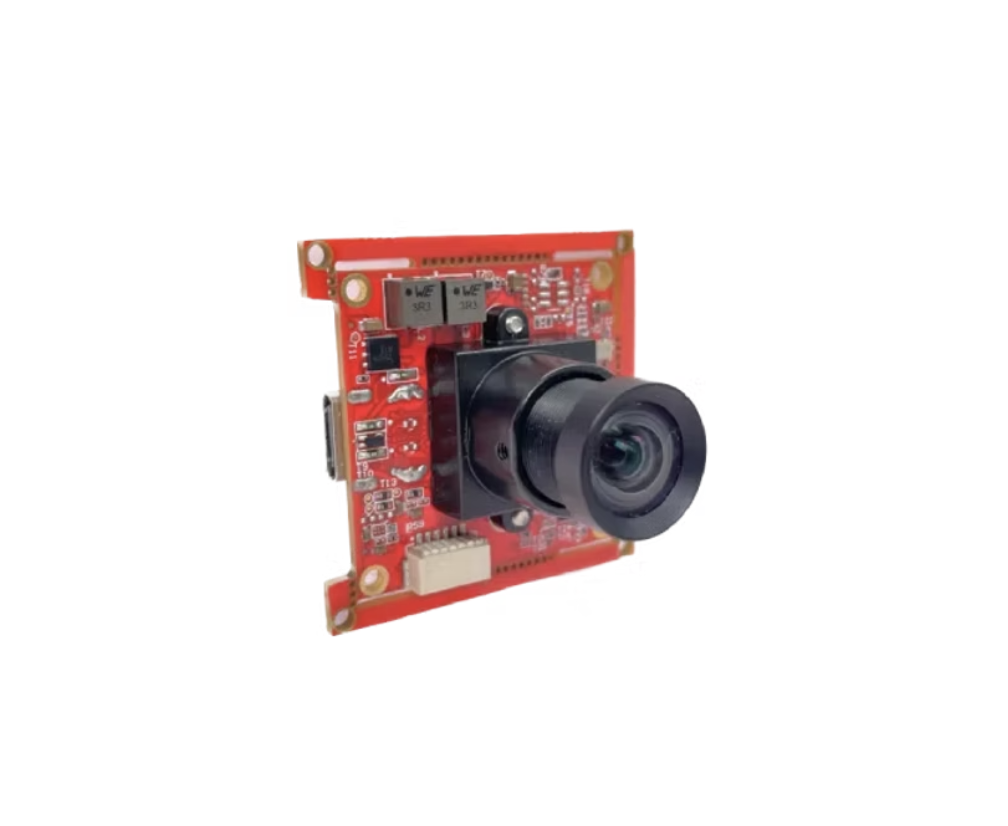
Product Overview
The Falcon-234MGS is a 2MP monochrome USB module built on the Onsemi AR0234 sensor and positioned for motion-accurate aerial inspection and UAV navigation. As an AR0234 Global Shutter Mono USB Camera, it keeps geometry true during flight, and as an AR0234 Full HD USB Camera, it streams 1080p at 60 frames per second. The 2MP Full HD Mono USB Camera designation covers its Full HD mode in Y8 format, and the 2MP Motion Accurate Mono USB Camera designation reflects its use on moving aircraft. The module combines the sensor, an onboard ISP, and a USB interface with an S-Mount (M12) lens holder. It also serves as a 2MP Full HD Monochrome USB Camera, an AR0234 Full HD Global Shutter USB Camera, a 2MP Global Shutter Monochrome Camera, an AR0234 Mono USB Camera, and an AR0234 Global Shutter Mono Camera for designs that need a standard interface.
Key specs: 2MP (1920 x 1200) Max Resolution | Onsemi AR0234 1/2.6 inch Sensor Format | 3.0 micron Pixel | Monochrome with Global Shutter | USB 3.2 Gen 1 Interface | S-Mount (M12) Optics
Key Capabilities of the AR0234 Mono Global Shutter USB Camera
Monochrome Imaging for Brightness-Based Vision Systems
A monochrome sensor has no color filter array, so more of the incoming light reaches each pixel, and it needs no demosaicing, so every pixel is a real measurement of brightness. For navigation and inspection software that works on luminance, this means cleaner frames, finer effective detail, and no color fringes. A 2MP Mono UVC USB Camera also has the near-infrared response of the bare sensor, which suits flights under infrared illumination. Teams that fly in the dark can pair the camera with an infrared illuminator and an optical filter chosen for the band.
Global Shutter Capture for Motion Analysis
A global shutter exposes every pixel at the same instant, so vibration, banking, and speed do not bend the picture. Navigation software measures how features move between frames, and a rolling shutter makes the wobble of the airframe look like real motion. The global shutter removes that error, which makes the camera an AR0234 Motion Blur Free USB Camera in the sense that short exposures and simultaneous capture limit blur and skew. It does not remove lens distortion, which depends on the optics. In the narrow sense of skew and wobble, the module is a 2MP Distortion Free Mono Camera, and the lens still needs calibration for straight lines. Vadzo can advise on calibration targets and on lenses with low distortion during evaluation.
50Hz and 60Hz Anti-Flicker Control for Artificial Lighting
Fluorescent and LED lamps flicker at twice the supply frequency, which is 100Hz on a 50Hz supply and 120Hz on a 60Hz supply. A mismatched exposure shows dark bands rolling through the picture, which confuses feature trackers. The ISP applies anti-flicker settings for both supplies, so one hardware design serves every region, and flights in warehouses, tunnels, and other lit structures stay clean. A short recording under the real lamps confirms that the bands are gone.
Full HD Imaging at 60 FPS
Full HD is the working resolution for most aerial navigation and inspection software, because it gives enough detail while keeping data and processing manageable. As a Full HD USB Camera and a 1080p Full HD USB Camera, the Falcon-234MGS streams 1080p, and the sensor’s native 1920 x 1200 grid leaves extra rows for cropping or stabilization. Teams can choose Full HD for navigation and keep lower modes for other tasks, and the same camera can serve a pilot view and a recording at once.
Onboard ISP for Image Processing and Exposure Control
The onboard image signal processor finishes the picture inside the module, applying denoising, gamma correction, auto exposure, and anti-flicker. The flight computer receives a processed frame and does not spend its own capacity on those steps, which suits compact computers with limited power. Teams that need raw data and custom tuning should discuss a raw sensor module with Vadzo instead. For most UAV projects, a finished image from the first day shortens development.
Full HD, 720p, and VGA Frame-Rate Options
The module streams 1080p at 60 frames per second, 720p at 60 frames per second, and VGA at 90 frames per second. Teams choose the mode that suits the task. Full HD suits mapping and inspection, 720p at 60 balances detail and processing, and VGA at 90 suits fast feature tracking where low delay matters more than detail. A 2MP Mono High Speed USB Camera of this kind lets one module serve several roles. Teams can switch modes in software as the mission changes.
Y8 Monochrome Output for Efficient Video Processing
Y8 stores one byte of brightness per pixel and no color information, so the stream is half the size of a 4:2:2 format and needs no color conversion on the host. At 1080p and 60 frames per second, the stream is about 124 megabytes per second, which fits through USB 3.0. Software that reads grayscale frames can use the data directly. Teams that need color for a particular task can add a second, color module to the payload, and Vadzo offers matching color USB modules on the same sensor family.
BMP and JPEG Still-Image Capture Options
Records and reviews often need a single frame. The module captures stills in BMP and JPEG. BMP preserves every pixel without compression, which suits measurement and archives, and JPEG compresses the image to a much smaller file, which suits review and sharing. Many teams capture BMP for the record and JPEG for the preview. As an AR0234 Mono USB Camera Manufacturer, Vadzo supports lens matching, firmware customization, and enclosure design for volume programs. Teams moving from a bench test to a flight test keep the same module and documentation.
“UAV software does not care about color. It cares about light, geometry, and frame rate. The Falcon-234MGS was positioned around those three things. The monochrome sensor collects more light per pixel and needs no interpolation; the global shutter keeps edges straight while the aircraft shakes, and the Y8 stream lets Full HD run at 60 frames per second through a standard USB cable. We are also clear about the limits. A global shutter does not remove lens distortion, and a 2MP sensor covers a modest footprint per frame, so we encourage customers to calculate ground resolution and plan calibration for their lens, and to record real flights before they fix the payload design.” – Alwin Vincent, Product Manager, Vadzo Imaging.
Applications of the Falcon-234MGS for UAV Inspection and Navigation
UAV-Based Inspection of Towers, Roofs, Solar Panels, and Pipelines
Inspection flights examine towers, roofs, solar arrays, and pipelines at close range, where the aircraft moves slowly and detail matters. The Falcon-234MGS works as an Aerial Inspection USB Camera and an Aerial Inspection Mono USB Camera that delivers clean luminance frames, with no color fringes at edges, for crack and corrosion detection. Teams should match the lens to the standoff distance and plan calibration for the lens distortion, and they should keep the lens clean, since dust and smears show clearly in a sharp monochrome image. Slow, steady passes near a structure reward a camera that keeps edges straight.
Global Shutter Imaging for Moving UAV Inspection Passes
Inspection passes happen at speed, and a slightly blurred or skewed frame can hide a defect or create a false one. As a motion-accurate aerial inspection USB Camera, the module exposes every pixel at once and uses short exposures that its light-gathering allows, so edges stay straight and sharp. Operators can record full frames for review while the pilot watches a lower-resolution view, and the monochrome frames compress well because they carry no color information. A short test pass over a known structure confirms that straight edges stay straight in the footage.
UAV Navigation and Visual Odometry with Monochrome Images
Navigation software estimates motion from the changes between frames, and distortion corrupts that estimate. The module serves as a UAV Navigation USB Camera and a UAV Visual Navigation USB Camera whose global shutter keeps frames geometrically consistent, and whose 60 and 90 frames per second modes keep the movement between frames small. Flights where satellite positioning is weak, such as indoors or under structures, rely on visual navigation even more. Teams should test navigation software on recorded footage from the real aircraft before the first autonomous flight, and they should replay the same footage after every change to the camera settings so that results stay comparable.
USB Camera Integration for UAV Payloads and Flight Computers
Aircraft payloads have tight limits on weight, power, and vibration. The module connects over a single USB cable, opens as a UVC device without a proprietary driver, and applies anti-flicker settings for flights under artificial lighting. Teams should confirm weight and power against the product documentation, check the operating temperature for the climate they fly in, secure the lens and the connector against vibration, and mount the camera on a damped mount or gimbal, since a global shutter prevents skew within a frame but does not stabilize the picture from one frame to the next. Strain relief on the USB cable also prevents most connector problems in flight, and a locking connector adds further margin on aircraft that vibrate strongly.
Frequently Asked Questions
Q: Why use a monochrome camera for UAV navigation?
A: Vadzo Imaging explains that navigation and most inspection software work on brightness, not color. A monochrome sensor has no color filter array, so more light reaches each pixel, and it needs no color interpolation, so every pixel is a real measurement. That gives cleaner frames and finer effective detail than a color sensor of the same resolution. A 2MP Global Shutter Monochrome Camera therefore suits software that tracks features, and Vadzo Imaging offers color modules for work that needs color, and a 2MP Full HD Monochrome USB Camera suits software that ignores it.
Q: How much data does a monochrome video stream use, and can USB carry 1080p at 60 frames per second?
A: Y8 video uses one byte per pixel. A 1080p stream at 60 frames per second needs about 124 megabytes per second, which is about 1 gigabit per second. USB 3.0 can carry that, while USB 2.0, at about 35 to 40 megabytes per second in practice, cannot. A 4:2:2 color stream needs twice as much data. Vadzo Imaging recommends measuring throughput on the real flight computer, since the host affects the result, and a 2MP Mono High Speed USB Camera can run faster modes when the link allows.
Q: What is Y8 video?
A: Y8 is a video format that stores one 8-bit brightness value per pixel and no color information. It is the natural output of a monochrome sensor, and software that reads grayscale frames can use it directly without color conversion. A 2MP Mono UVC USB Camera can stream Y8 over a standard USB connection, and Vadzo Imaging suggests checking that the chosen software accepts the format, since a mono sensor sends Y8 natively.
Q: Does a global shutter remove all image distortion?
A: No. A global shutter removes the skew and wobble that come from reading the picture row by row while the camera moves. It does not remove the distortion that comes from the lens, which bends straight lines, especially with wide-angle optics. Teams that need a rectilinear image should calibrate the lens and correct the distortion in software or in a dedicated processing step. Vadzo Imaging helps customers choose the lens and plan the calibration, because a wide lens needs correction for straight lines.
Q: Why should UAV makers choose Vadzo Imaging as their monochrome USB camera manufacturer?
A: Vadzo Imaging offers more than a camera module built around a capable sensor. UAV makers working with Vadzo Imaging receive a monochrome global shutter module with an onboard ISP, anti-flicker control, and Full HD streaming at 60 frames per second, along with candid guidance on data rates, exposure, and lens distortion, plus engineering support for lens selection, firmware customization, and enclosure design. Vadzo Imaging maintains evaluation kits with no minimum order requirement, so teams can test on their own aircraft before committing to volume production.
Availability
The Falcon-234MGS AR0234 Mono Global Shutter USB Camera built on the Onsemi AR0234 sensor is available now for evaluation and production orders. Evaluation kits include the camera module, an S-Mount lens, a USB cable, and platform documentation, with no minimum order requirement, so a team can mount a unit on a test aircraft and fly it within days. UAV teams can test motion handling on their own airframe, measure data rates on their own flight computer, and check anti-flicker under their own lighting before committing to a production bill of materials, which tells them more than a datasheet comparison alone. Teams that need a different lens can ask Vadzo to review the configuration. Browse the full range of USB camera options at Vadzo’s website or discuss OEM integration requirements for UAV programs.
About Vadzo Imaging
Vadzo Imaging is a global provider of embedded vision solutions and delivers high-performance camera technologies and imaging platforms for applications in robotics, industrial automation, UAVs, edge AI, and medical systems. Its products are designed for seamless integration with leading embedded platforms. Vadzo supports customers through hardware customization, firmware development, and module-level drivers, enabling faster development and deployment of vision based systems across USB, MIPI, GigE, Wi-Fi, and SerDes camera interfaces.
Media Contact
Alwin Vincent
Vadzo Imaging
Email: alwin@vadzoimaging.com
LinkedIn: Vadzo Imaging
YouTube: Vadzo Imaging
X: Vadzo Imaging
SOURCE: Vadzo Imaging
View the original press release on ACCESS Newswire
Media gallery
