PixAI Launches Tsubaki.3, an All-in-One Creative Engine for Every Step of the Creative Process
PixAI’s Tsubaki.3 is designed to support creators throughout their workflow, from a first character sketch to a
Press Release Disclaimer: This is a press release distributed through the XPR Media network. It has not been independently verified by our newsroom.
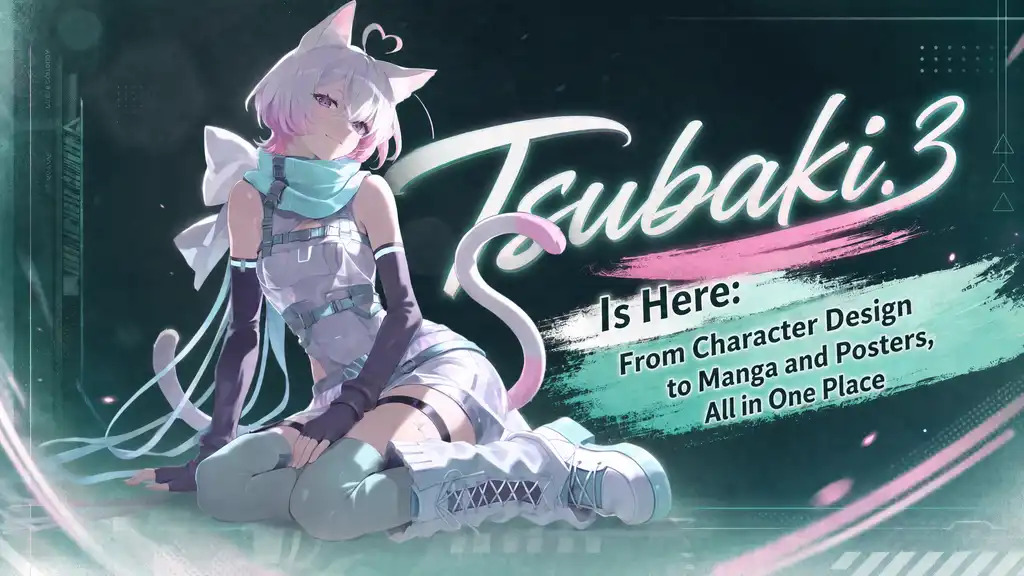

PixAI’s Tsubaki.3 is designed to support creators throughout their workflow, from a first character sketch to a finished page or scene.
NEW YORK CITY, NY, UNITED STATES, September 18, 2026 /EINPresswire.com/ — PixAI, the global AI creation platform for anime-style visual content, today announced the full release of Tsubaki.3, its next-generation manga, image, and video creative engine. Tsubaki.3 is built to work alongside a creator at any stage of a project: generating a first concept, developing a character further, editing a specific detail, composing a full scene, creating an animated short, or laying out a comic page, all within the same creative engine that is Tsubaki.3.
Anime and visual novel creators tend to have a clear vision for their characters and stories, and they expect their tools to keep pace with that vision rather than flatten it. “We built Tsubaki.3 to fit into how creators actually work, not just to produce a single striking image,” said a PixAI spokesperson. “Anime and comic creators move through a lot of steps between an idea and a finished piece, and we wanted a tool that’s useful at every one of them.”
The core of Tsubaki.3 is a “Reference, Edit, Develop” approach to visual narrative creation. Creators can reference up to three images at once to extend a character they’ve already made: new expressions, outfits, poses, turnarounds, or age variations, without retraining a custom model from scratch. Creators can edit in plain language, describing what to change (a hair color, a pose, an added prop) and what to keep (composition, lighting, background). And they can develop the result further into new scenes, panels, or formats as a project evolves.
To tackle the issue of multi-character composition, Tsubaki.3 puts specific effort into keeping each character’s appearance, position, gaze, and pose distinct when multiple people share a frame, including scenes where characters are physically interacting with each other or with objects.
Lighting and camera control also got a comparable upgrade in Tsubaki.3. Compared to its previous version Tsubaki.2, the new model brings direction, intensity, color temperature, depth of field, focal length, backlight and hard-light setups, underwater lighting, silhouette work, film grain, and lens flare, all available as prompt controls, giving creators fine-grained control over their output.
Anime creators often work within a specific visual style: a subgenre’s color grammar or a niche aesthetic that a general-purpose model tends to flatten out. To hold onto that specificity, Tsubaki.3 also introduces “Recipes,” letting creators package a style or prompt template they’ve developed and share it for others to use directly, or browse and remix based on an existing style. Popular Recipes so far span a wide range, from Pastel and Semi Realistic to Holographic and Vintage Collage.
Tsubaki.3 also adds support for rendering text within an image across several languages, including English, Japanese, Korean, and Traditional Chinese, useful for titles, signage, or dialogue elements that are part of the composition rather than added afterward.
For comic and manga-style creators, Tsubaki.3 supports full multi-panel page composition in a single generation, including panel layout, framing, close-ups versus wide shots, and multiple camera angles, built from a text description of the story beat and optionally a creator’s own reference character. The goal is to support the parts of story development that are genuinely tedious, like thumbnailing, panel blocking, and page layout, so creators can spend more time on the story itself.
Alongside Tsubaki.3, PixAI is releasing Tsubaki Video and Tsubaki Video Flash, extending the same reference-driven approach to motion: camera movement, scene depth, and character-consistent animation.
The release kicks off PixAI’s broader 4th anniversary campaign, which runs through October 20 and includes a global creator contest open to all users, with PixAI credits and gift cards awarded to winners. As part of the anniversary, PixAI is also folding community-made work into its own storytelling: content created by PixAI community artists are being featured as part of the platform’s official anniversary content.
About PixAI:
PixAI is an anime-style AI art platform. Powered by its proprietary image foundation model Tsubaki.3. Since launching in October 2022, PixAI has grown to more than 16 million registered users worldwide, with strong communities in Korea, North America, and Taiwan. Beyond the Tsubaki model series, PixAI offers Mio.2, a conversational AI creation agent, PixAI Edit Pro, a natural-language image editing model, and PixAI Studio, a node-based creative workspace connecting image, video, text, and audio generation and editing.
Shanshan Long
Mewtant inc.
+1 929-541-9770
email us here
Legal Disclaimer:
EIN Presswire provides this news content “as is” without warranty of any kind. We do not accept any responsibility or liability
for the accuracy, content, images, videos, licenses, completeness, legality, or reliability of the information contained in this
article. If you have any complaints or copyright issues related to this article, kindly contact the author above.

Media gallery